
news and events
Will they believe me?
Reliability and Credibility in Sexual Harassment at Work cases
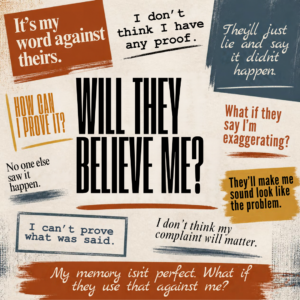
These are just a handful of phrases that I often hear from clients when it comes to moving forward with their sexual harassment at work case. They all strike at the same fear: my case will be dismissed because people will think I’m a liar.
Why people worry about being believed
Sadly, the criminal justice system is not easy for survivors of sexual violence. High profile cases such as 2025’s R. v. McLeod, et al. (the World Junior Hockey Canada team trial) and 2016’s R. v. Ghomeshi as well as countless others put survivor’s credibility to the test. Our adversarial criminal legal system does not always properly take into account the effects of trauma on a survivor’s memory, and attacks credibility based on behaviours that seem contrary to what a ‘reasonable person’ would do – forgetting or ignoring that sexual assault is not a reasonable activity and there is no ‘correct’ way to respond. Seeing someone’s testimony torn to shreds can certainly discourage clients and lead them to believe they won’t be believed.
Civil Matters versus Criminal Court
Civil courts do not have the same burden as proof as the criminal court. As we all know from our favourite TV crime shows, the burden of proof at the criminal level is “beyond a reasonable doubt.” One way to raise reasonable doubt is to demonstrate there is another reasonable explanation for the facts. In contrast, the burden of proof at the civil court is “on a balance of probabilities,” meaning ‘what is more likely to have happened.’
As established in F.H. v. McDougall, survivors of sexual harassment in the civil courts don’t need to show that there isn’t another reasonable explanation for what happened; they only need to show that their explanation is the more reasonable and likely one.
Which doesn’t mean any explanation will do – the explanation must be one that is “more likely than not” given all of the circumstances. The decision maker has to rely on evidence that is “clear, convincing and cogent in order to satisfy the balance of probabilities test.” In other words, the decision maker has to decide whose testimony and evidence seems the most reliable and credible.
And that brings us back to where we started.
What is reliability and credibility?
Credibility is the quality of believability through a person’s honesty and sincerity. Does the speaker honestly seem to be telling the truth as they sincerely believe it?
Reliability is the quality of being able to count on (or rely on) what is being said. Is there inner coherence to the story? Is there external corroboration of the story? Does it seem plausible from a ‘common-sense’ approach?
You can find someone credible, but not reliable. For example, someone can honestly believe that something happened in a certain order or in a certain way, for example that they were not in the building at the time of the incident; but the documentary record tells a different story, and there is date-stamped video footage of the person being in the building.
In order to succeed in a civil or administrative claim, you will need to persuade the trier-of-fact that you are both credible and reliable, and that as a result, they should conclude that on a balance of probabilities what you are saying is the truth.
So how is your reliability and credibility determined? The courts have grappled with that issue, and case law provides guidelines and tests that can be applied.
Legal tests for assessing testimony
You can’t discuss reliability and credibility without talking about Faryna v. Chorny. This foundational case determined that the demeanour of the witness, meaning how truthful they might seem, is not the only gauge of truth. Witnesses can believe something to be true, without it being true.
In F.H. v. McDougall, the Supreme Court of Canada did two important things. They rejected the idea that ‘serious allegations’ come with a different or higher burden of proof. There are only two standards of proof: beyond a reasonable doubt, in criminal cases, and in civil cases, on a balance of probabilities. A witness’s evidence must be “sufficiently clear, convincing and cogent” to satisfy the standard. Findings of credibility and reliability are required in order to determine if the burden is met.
A non-exhaustive list of factors to be considered by decision makers was articulated in Bradshaw v. Stenner. The courts look at the ability of the witness to observe and remember the events; what interest they have in the outcome that might colour their recollection and whether or not they have a motive to lie; the internal consistency of their statement, along with the consistency with previous statements and during cross-examination; whether there is corroborating documentary evidence; and whether the story appears plausible or reasonable considering all the circumstances.
Finally, R. v. Morrissey, teases out in particular that a witness can be credible, but unreliable, and more importantly, they may be reliable on some points, but not on others. This is important because it means that credibility and reliability aren’t “all or nothing” propositions: rather, it reflects that a witness may have memories that are affected in different ways, may have reasons for being more open at some times and less open at others, and that ultimately the whole context must be viewed to come to a determination.
To sum up, when you or a witness are giving testimony, the decision-maker will weigh your words, the documentary record, the reliability and credibility of other witnesses, the ‘totality of the circumstances’ and determine if you are credible and reliable, or credible but unreliable, or reliable on some points but not others, or worst case, neither reliable nor credible.
Your Word Against Theirs
Can you succeed if it is your word against theirs?
No one can guarantee that you will get the outcome that you want if you bring claims of sexual harassment at work to the courts or to an administrative tribunal. The truth of your statements will be examined for their reliability and credibility, and in civil forums, the outcome will be determined on a balance of probabilities.
You can be believed even if it is your word against theirs. Your memory doesn’t have to be perfect. If neither side has ‘proof,’ meaning corroborating documents or evidence, you can still be seen as reliable and credible. Although not perfect, courts and tribunals are increasingly recognizing the effects of trauma on memory, and on behaviour. If you have documents that can support your story, that will help bolster your reliability and therefore your credibility. Even if you are nervous, or come off awkward, or are confused, you won’t be dismissed just because of the way you present. If they lie, and their story is inconsistent, or doesn’t seem likely based on all the circumstances, or can be shown to contradict documentary evidence, then you may be believed. If they say you are the problem, or you are exaggerating, the decision maker will weigh that against the circumstances, and take into consideration their motives for saying those things.
Your words and your testimony do matter, and it is worth standing up for your rights.
If you have been subject to sexual harassment in the workplace, we can help. Call 1-833-677-5146 for free legal advice.